
When choosing between Nauru and Dominica for citizenship by investment, the difference is stark. Dominica is the established, time-tested option with a proven track record and far superior travel benefits. The Dominica Citizenship by Investment (CBI) program offers a clear legal framework and visa-free access to approximately 145 countries, including Europe's Schengen Area. In contrast, Nauru’s program is a brand new 2024 initiative. It has an unproven track record and significantly fewer visa-waiver agreements.
Citizenship by Investment (CBI) - A process where an individual makes a significant economic contribution to a country, such as a donation or real estate investment, in exchange for being granted citizenship and a second passport. These investor citizenship schemes are regulated by national laws.
What Is the Legal Foundation for Each CBI Program?
The legal history of a CBI program is a critical indicator of its stability and international acceptance. Dominica’s program is one of the oldest and most respected in the world. Nauru’s was established only in 2024. That creates a sharp contrast in legal maturity.
Grounded in Section 8 of the Commonwealth of Dominica Citizenship Act (Chap. 1:10) and further detailed by the Citizenship by Investment Regulations, Dominica's program has a decades-old legal basis. It's been amended over time but provides a predictable and tested framework for applicants.
Nauru’s program, on the other hand, was just created by the Nauru Economic and Climate Resilience Citizenship Act 2024 (No. 15 of 2024). This new law establishes the "Nauru Economic and Climate Resilience Citizenship Program" as a special regime layered onto the existing Citizenship Act 1963 (Nauru). As a new program, its due diligence standards and international standing are not yet established. This means early applicants are essentially test subjects for a process that lacks precedent, which could lead to unexpected delays or rule changes mid-application. It's a key concern highlighted in standards like INTERPOL General Assembly Resolution AG‑2017‑RES‑06, which calls for robust vetting in all CBI programs.
How Do the Investment Options and Costs Compare?
The financial requirements are a core component of any CBI program. Dominica offers clear, long-established investment routes with transparent costs. Nauru's options are newer and less detailed in public-facing regulations, making a true cost comparison difficult for prospective investors.
Dominica Citizenship by Investment Cost
Dominica provides two primary pathways to economic citizenship. Both are managed by its official government body, the Citizenship by Investment Unit (CBIU).
- Economic Diversification Fund (EDF): The most common route is a non-refundable contribution to this government fund, which finances public and private sector projects. The minimum donation for a single applicant is USD $100,000.
- Real Estate Investment: An applicant may invest in government-approved real estate with a minimum value of USD $200,000. This property must be held for a minimum of three years; selling it earlier would likely result in the revocation of your citizenship. Additional government fees, which are separate from the property cost, also apply.
These options have been part of the Caribbean citizenship by investment landscape for many years, offering a high degree of predictability.
Nauru Citizenship by Investment Cost
While the Nauru Economic and Climate Resilience Citizenship Act 2024 creates the legal mechanism for investment, the specific contribution amounts are not as publicly codified as Dominica's. Initial reports and program marketing suggest a minimum investment contribution starting around USD $150,000 directed to the Nauru Treasury Fund. Still, as the program is new, these figures and the projects they fund lack the long-term track record of their Caribbean counterparts.
What Is the Application Process and Timeline?
Dominica’s process is highly structured and transparent, typically taking three to six months from submission to approval. Nauru's process is new and lacks a documented public track record, introducing an element of uncertainty.
Both programs mandate that applicants use an accredited agent and undergo rigorous, multi-layered due diligence checks. These background investigations are non-negotiable. They are designed to verify the applicant's identity and the legal source of their investment funds. Once all checks are complete and the investment is made, the government issues a Certificate of Naturalisation—the legal document conferring citizenship—which then allows for a passport application.
Dominica Citizenship by Investment Time
The process, managed by the CBIU, follows a reliable sequence:
- Submission: An authorized agent submits the complete application package to the CBIU. A simple mistake here, like a missing signature, can delay the start of the entire process by weeks.
- Due Diligence: The CBIU commissions checks from reputable international third-party firms. This is the longest phase, typically taking 30 to 60 days.
- Approval: Upon successful vetting, an "approval-in-principle" is issued. Only then does the applicant make the required investment or donation.
- Naturalisation: After the funds are received, the Certificate of Naturalisation is issued, and a passport can be applied for. The entire timeline is reliably between 3 and 6 months.
How to get a Dominica Passport
Obtaining the passport is the final administrative step after citizenship is legally granted. Once you receive your Certificate of Naturalisation from the Government of Dominica, your authorized agent can immediately submit an application for your Dominican passport. The passport book itself is typically issued within a few weeks of the application.

Which Passport Offers Better Visa-Free Travel?
For most investors, global mobility is the primary goal. Here, the Dominica passport offers a significant and established advantage over Nauru's.
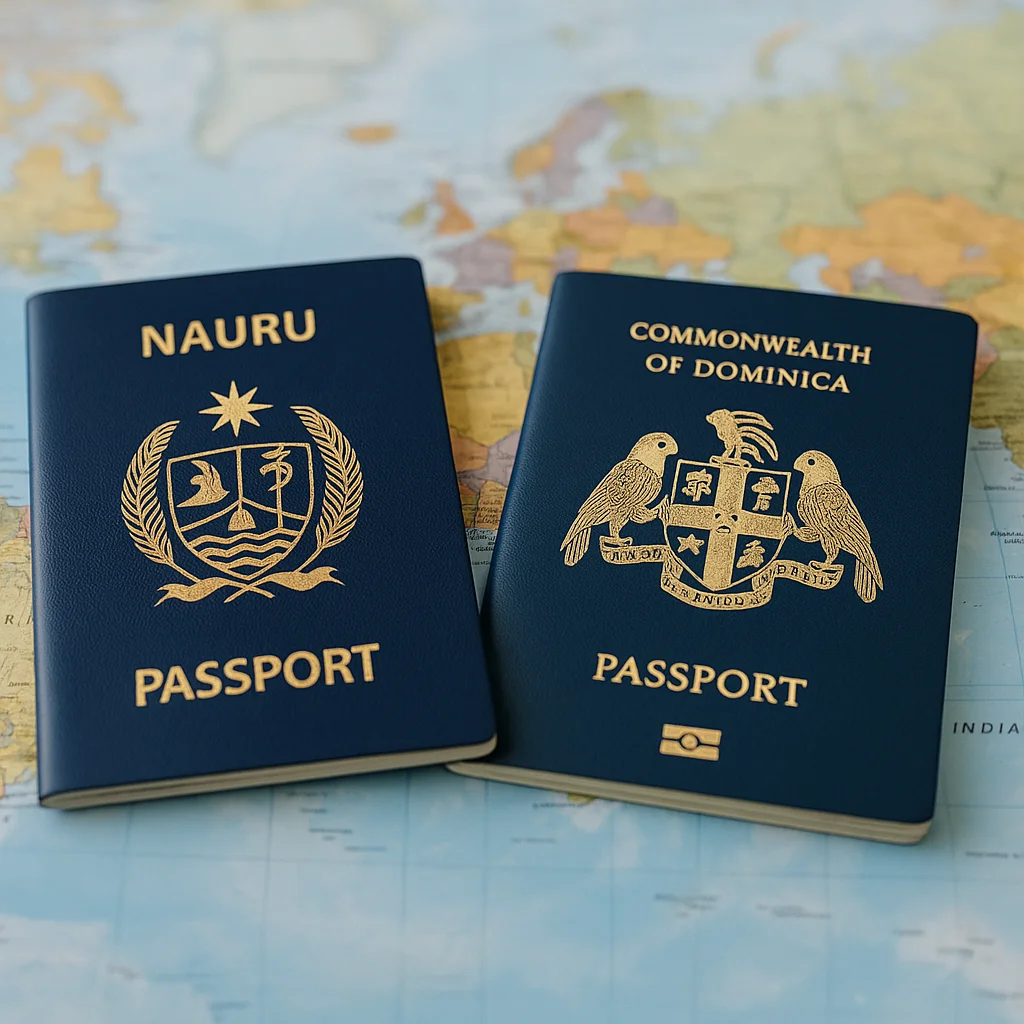
The Dominica passport provides visa-free or visa-on-arrival access to approximately 145 countries and territories. Its key advantage is the visa-waiver agreement with the Schengen Area, allowing its citizens to travel throughout 27 European nations for up to 90 days in any 180-day period. This access makes it a powerful tool for global business and personal travel.
In stark contrast, the Nauru passport offers substantially less travel freedom, with visa-free access to only around 88 countries. Crucially, it does not have a Schengen visa-waiver agreement. This means Nauruan citizens must apply for a visa to enter Europe—a major logistical and practical disadvantage compared to Dominica.
Dominica Passport Ranking and Visa-Free Countries
The strength of Dominica's travel document is a primary driver for its popularity. Key visa-free destinations include:
- The European Union Schengen Zone
- Hong Kong
- Easy travel to Singapore
- Russia
- Access to much of Latin America
While visa-free access to the United Kingdom is currently suspended for Dominica and under review, its powerful access to the EU and Asia remains intact, placing it in a much higher tier of passport rankings than Nauru.
⚠️ Time is critical — every day matters
Get a free case assessment
Our team specialises in cases with an international element. We review applicable treaties, assess risks, and prepare an action plan.
This article is published by an independent law firm for informational purposes only and does not represent or claim affiliation with any government body, international organization, or official authority.
Considering this programme?
Get a free, confidential consultation about eligibility, cost and the process.
Book a free consultationFrequently asked questions
Is Nauru or Dominica better?
It depends on your goals — mobility, cost, timeline and recognition differ; compare against current official information.
Which has stronger visa-free access?
Access differs and changes over time; check a current index for each passport before deciding.
Are both programmes official?
Dominica's CBI is long-established; Nauru's ECRCP is newer — verify current status for each.
Which suits me?
Consider your budget, travel needs and risk appetite, and take independent advice.